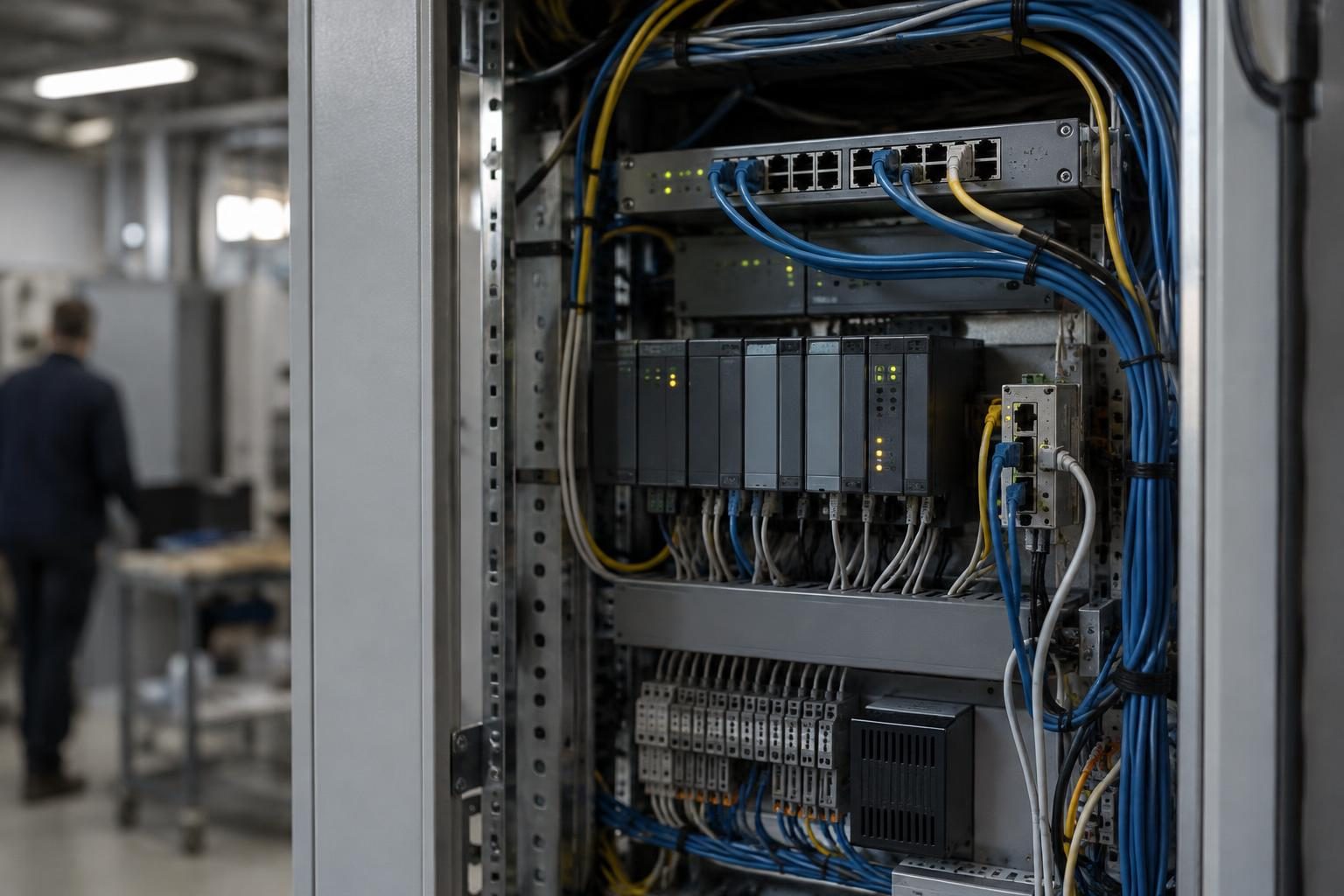

A cyber attack on refrigeration controls at about 700 French supermarkets forced retailers to discard food after intruders changed operating temperatures, according to an analysis published by BC Training Bulletin on 16 October 2026. The reported disruption began overnight on 11–12 October, illustrating how access to connected equipment can translate into physical damage and immediate commercial losses.
Writing in the bulletin, Charlie, identified by first name only, argues that the incident should prompt continuity teams to examine internet-connected machinery alongside conventional IT risks. For UK and European organisations, the central issue is not confined to supermarkets: equipment used to maintain essential operating conditions can itself become a route to business interruption.
What happened
The bulletin reports that attackers reached refrigeration systems over the internet and altered temperature settings, in some cases to 50°C. Food in affected units spoiled, while some incidents reportedly involved fires or sprinkler activation. The account does not establish how those additional events developed or how extensively they occurred.
In one reported case, an extended defrost cycle prevented the refrigeration system’s alarms from activating. That detail raises a separate operational concern: interference with equipment settings may undermine the warnings on which staff depend, rather than simply create an obvious system failure.
Further attacks were reported the following night, involving Dixell refrigeration systems. The retailers named as affected were Intermarché, Netto, Carrefour, Monoprix, Coopérative U and E.Leclerc. Carrefour reported disruption at 80 supermarkets; Monoprix said approximately 5 per cent of its roughly 490 stores experienced problems.
The financial estimates remain incomplete. The bulletin cites Intermarché chief executive Thierry Cotillard as estimating nationwide losses in the tens of millions of euros within a day. It also relays SecurityWeek’s report of €270,000 in combined losses at two Alsace supermarkets. Those figures describe different scopes of damage and should not be treated as a consolidated industry total.
France’s national cyber security authority, ANSSI, initially identified compromised Danfoss controllers, according to the bulletin, before broadening its warning to cover Copeland systems and its Dixell brand. The involvement of several suppliers means the reported disruption cannot be understood solely as a problem affecting one manufacturer’s equipment.
At publication, the bulletin reported neither an attribution nor a public claim of responsibility or ransom demand. Charlie discusses several possible explanations, but supplies no evidence establishing an attacker or motive. Unlike the criminal activity examined in our coverage of the Hive and Nefilim ransomware case, this account does not establish an extortion operation.
The background
Refrigeration controllers form part of operational technology: systems that monitor or influence physical processes. Internet connectivity can support alarms, remote diagnostics and maintenance. Charlie’s argument is that those useful functions also require organisations to assess who can reach the equipment and what an unauthorised change could do.
The bulletin relays commentary that Danfoss identified most affected devices as older AK-SM 800 and AK-SC 355 systems no longer receiving security updates. Some newer AK-SM 800A controllers reportedly ran outdated firmware. Unsupported equipment and unmaintained software therefore feature prominently in Charlie’s assessment, although the precise intrusion method remains unconfirmed.
Operational technology security company Claroty had previously disclosed weaknesses in certain refrigeration controllers, and manufacturers had produced patches. Crucially, the bulletin does not establish whether those particular flaws were exploited. The wider question of connected-device security also informs our coverage of GoAhead TLS flaws and device trust checks, without implying a technical connection between the stories.
Charlie also highlights supplier access, describing a power company that required its generator manufacturer to request time-limited remote connections rather than maintain permanent access. The example illustrates his preferred control, not a finding about how the supermarket attackers entered. Supplier relationships can create distinct security dependencies, as explored in our reporting on partner marketing systems and the Engie customer data breach; here, the concern is access to machinery rather than customer records.
What people are saying
Charlie’s analysis in BC Training Bulletin places particular weight on the economics of recovery. Supermarkets operate with narrow margins, he notes, so the revenue needed to offset destroyed stock can substantially exceed its value. Restoring equipment to working order is therefore a different milestone from recovering the commercial loss.
His recommendations also extend to contractual responsibility. Where equipment is supplied or operated by another business, he argues, organisations should establish who bears the cost of spoiled goods and the work of replenishing them. The bulletin does not identify the contractual arrangements at the affected retailers or establish whether any supplier faces liability.
Charlie raises refrigeration supplied as a service as a hypothetical example, explicitly acknowledging that he does not know whether such an arrangement is available. His broader point concerns outsourced operations: responsibility for running equipment, responding to failure and paying for the consequences should not be assumed to sit with the same party.
Insurance is another part of that assessment. The bulletin urges organisations to understand the cover held by each party, rather than treating a supplier relationship as evidence that losses will be reimbursed. It provides no details of claims or coverage decisions arising from the French incidents. The distinction between insurance arrangements and operational exposure also features in our reporting on mining insurance and deeper disruption risks.
On public reaction, Charlie argues that attacks affecting everyday necessities attract attention because their consequences are immediately recognisable. He draws a comparison with the M&S cyber attack, suggesting that familiarity with a retailer helps explain the prominence of its disruption. This is his interpretation of the coverage, rather than evidence about the attackers’ choice of target.
He also leaves an important preparedness question unanswered: whether supermarket continuity teams had explicitly considered malicious interference with refrigeration in their risk registers. The bulletin reports no survey or findings on that point, so it cannot establish that retailers had overlooked the scenario.
What happens next
The bulletin offers no timetable for full recovery. Its forward-looking contribution is instead a set of proposals for continuity practitioners, beginning with a review of business impact analyses. Charlie recommends using that process to identify connected plant and assess the operational consequences of hostile interference, bringing machinery into an exercise often associated with the loss of business applications.
For UK and European organisations applying that recommendation, the useful distinction is between a technical asset inventory and an assessment of what operations depend on each asset. Identifying a controller is only the starting point; the continuity question is what its failure would prevent the business from doing. That is an implication of Charlie’s proposal, not a reported finding about the supermarkets’ planning.
He further recommends joint incident plans with critical suppliers. Those plans should address how the parties will manage a disruption together and how communications will be issued. A supplier’s technical response and a retailer’s operational response need to be considered as parts of the same incident, rather than separate exercises.
Testing those arrangements is a distinct priority in his analysis. Charlie acknowledges that organisations may lack time to exercise with every supplier, and proposes concentrating on a selection of critical relationships. Such exercises would examine the practical arrangements for collaboration, rather than rely solely on contractual descriptions of responsibility.
The outstanding reporting questions concern recovery as well as security: how long replenishment takes, how costs are allocated and whether joint response arrangements functioned as intended. The bulletin does not answer them. For continuity leaders, those details would help distinguish the immediate equipment disruption from the longer process of returning an affected operation to normal trading.